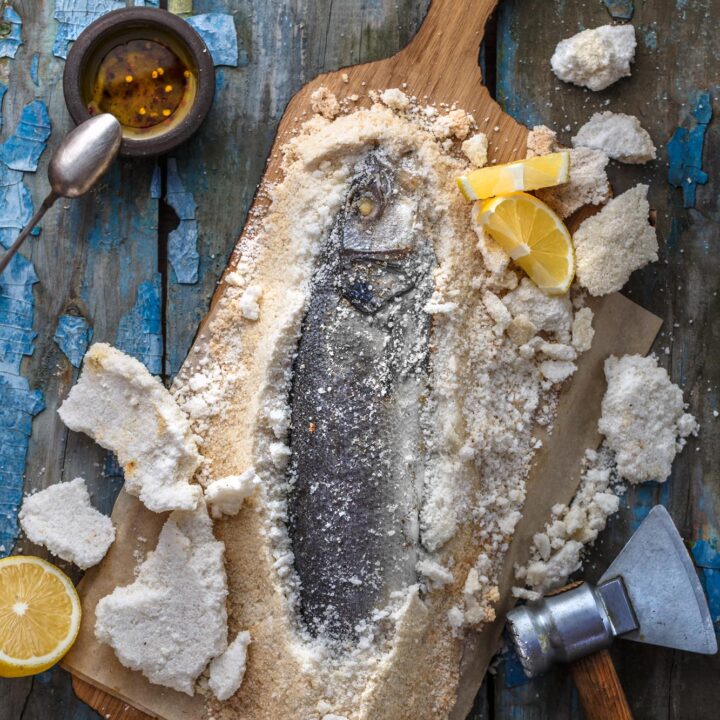
Salt-Baked Fish, also known as Pescado a la sal is a Spanish dish based on a cooking method of roasting the fish in salt. The result is a tender, juicy and tasty fish that also looks rather impressive.
Fish baked in salt with lemon and oil, deadpan style, rustic, top view
About Salt Baking Fish
The concept of salt roasting fish can be traced back to ancient times when various civilizations discovered the remarkable ability of salt to preserve food. The technique of salt baking originated as a way to preserve fish for longer periods, but over time, it evolved into a sophisticated culinary practice, celebrated for its ability to enhance the natural flavors of the fish while retaining its moisture.
To prepare salt-baked fish, a whole fish is generously coated with a thick layer of coarse sea salt, which acts as both a cooking vessel and a seasoning agent. The salt crust not only seals in the fish’s natural juices but also infuses it with a subtle hint of salinity, creating a harmonious balance of flavors. Additionally, the salt crust acts as an insulator, ensuring that the fish cooks evenly and gently, preventing it from drying out.
Making Pescado a la Sal (Salt Baked Fish)
The process for making Pescado a la sal begins with selecting the freshest fish possible, typically a whole fish with the skin and scales intact. Traditional choices include sea bass, snapper, or branzino, although any firm white-fleshed fish will work beautifully. The fish is then thoroughly cleaned, removing any scales and entrails while leaving the skin intact.
Next comes the creation of the salt crust. Coarse sea salt is mixed with egg whites and sometimes other flavorings like herbs, citrus zest, or spices, creating a moist sand-like texture. This mixture is carefully molded around the fish, covering it completely and ensuring a tight seal. The fish is then placed on a baking tray and transferred to a preheated oven, where it will roast at a moderate temperature.
As the salt crust hardens and forms a protective shield around the fish, the magic unfolds inside. The fish steams gently in its own juices, absorbing the flavors of the salt while remaining incredibly moist. The cooking time varies depending on the size and thickness of the fish but generally ranges from 25 to 45 minutes.
Once the baking time is complete, the salt-baked fish is brought to the table, where the culinary spectacle truly begins. The hardened salt crust is carefully cracked open, revealing the perfectly cooked fish within. The skin peels away effortlessly, exposing the tender, juicy flesh beneath. The aroma that escapes is simply irresistible, enticing everyone in its vicinity.
Serving Salt Baked Fish
To serve salt-baked fish, the fillets are gently lifted away from the bones, ensuring that none of the delicate flesh is wasted. The fish can be garnished with a drizzle of high-quality olive oil, a squeeze of fresh lemon juice, or a scattering of herbs, enhancing the flavors even further. The recipe here includes a simple garlic aioli.
The fish is often accompanied by simple sides like crusty bread, steamed vegetables, or a light salad, allowing the fish to take center stage.
The beauty of salt-baked fish lies not only in its exquisite taste but also in the sense of theater it brings to the dining experience. Breaking open the salt crust and unveiling the perfectly cooked fish creates a moment of anticipation and wonderment. It’s a dish that encourages sharing and indulging in the pleasures of food, evoking a sense of celebration and appreciation for culinary craftsmanship.
Whether enjoyed at an upscale seafood restaurant or prepared at home for a special occasion, salt-baked fish is a culinary treasure that never fails to impress. Its simplicity, elegance, and unparalleled taste make it a timeless classic that deserves a place in every seafood lover’s repertoire. So next time you seek to create a culinary masterpiece, consider the artistry of salt-baked fish and embark on a gastronomic journey that will leave you craving more.
600 gm sea bass, gutted and gills removed but scales retained
2 eggs
Small bunch of fresh flat-leaf parsley
Small bunch of fresh basil leaves
1 lemon
1 kg coarse sea salt
1 ½ tbsp fennel seeds
For the aioli:
50 ml Spanish extra virgin olive oil
50 ml olive oil
Pinch of saffron
3 garlic cloves, peeled
Sea salt to taste
Instructions
Set your oven to maximum temperature and warm it up.
Dissolve the rock sea salt in a couple of tbsp water and crack the egg into it.
Peel zest of the lemon into it, whisk them all together, along with the fennel seeds into a uniform, sticky mixture.
Spread 2/3 of it into a thick layer, across the bottom of a roasting pan and set it aside.
Pack the interior of the fish with the fresh herbs and place it on top of the salt layer.
Smother it with rest of the salt mixture so that it is about 1 ½ ‘’ thick.
Roast the salt-coated fish in the oven for about 20-25 minutes or until cooked through.
Take it out of the oven and check the doneness of the fish by sticking a sharp knife into its centre; set aside for about 10 minutes.
Meanwhile to make the aioli, place the garlic in a mortar and add a large pinch of salt as well as saffron into it.
Pound them with a pestle until they blend into a smooth, orangish paste and drizzle the olive oil in a thin stream, while whisking it into the paste using the pestle until well combined.
Blend the extra virgin olive oil into the paste, in a similar fashion and beat in a splash of the peeled lemon; adjust the seasoning and set aside.
Once the fish cools down and the outer salt covering hardens like a brick, tap its corners hard with the back of a spoon and peel off the salt covering completely.
Brush off any residual covering and place the fish on a plate.
Open up the fish flat by running a knife along its centre and peel off the skin.
Remove the bones and spoon the fish flakes on the serving plates.
Place a dollop of aioli on top of each fish flakes and serve right away.
This website uses cookies to improve your experience. Please accept for optimal usages of the site. AcceptRead More
Privacy & Cookies Policy
Privacy Overview
This website uses cookies to improve your experience while you navigate through the website. Out of these, the cookies that are categorized as necessary are stored on your browser as they are essential for the working of basic functionalities of the website. We also use third-party cookies that help us analyze and understand how you use this website. These cookies will be stored in your browser only with your consent. You also have the option to opt-out of these cookies. But opting out of some of these cookies may affect your browsing experience.
Necessary cookies are absolutely essential for the website to function properly. This category only includes cookies that ensures basic functionalities and security features of the website. These cookies do not store any personal information.
Any cookies that may not be particularly necessary for the website to function and is used specifically to collect user personal data via analytics, ads, other embedded contents are termed as non-necessary cookies. It is mandatory to procure user consent prior to running these cookies on your website.